The skeptics weren’t wrong to be cautious. Early DDC (Direct Digital Control) deployments had real growing pains: proprietary systems that couldn’t communicate with each other, programming that required specialized expertise, and a steep learning curve for technicians accustomed to working with their hands.
It took the adoption of open communication protocols, BACnet (Building Automation and Control Networks) becoming an ASHRAE standard in 1995, for the industry to truly standardize and scale. But eventually, DDC didn’t just prove itself. It made buildings function in ways pneumatics never could, and the HVAC technicians who adapted became better at their jobs because of it.
AI in commercial HVAC is the same conversation, playing out again. The skepticism is understandable. Some of it is well-founded. And a lot of buildings in Quebec are going to make expensive mistakes if they treat AI as a shortcut rather than a layer that requires everything underneath it to be solid first.
At SMP LebBlanc, we do air balancing, duct testing, and water balancing on commercial and institutional buildings across Quebec. Major mechanical contractors bring us in specifically because this verification work requires field judgment that automated systems cannot replace. Here’s our honest read on where AI helps, where it doesn’t, where human expertise still has to carry the load, and what that means for building owners making decisions right now.
What AI Is Actually Doing Well in Commercial Buildings
Let’s start with what’s real and working:
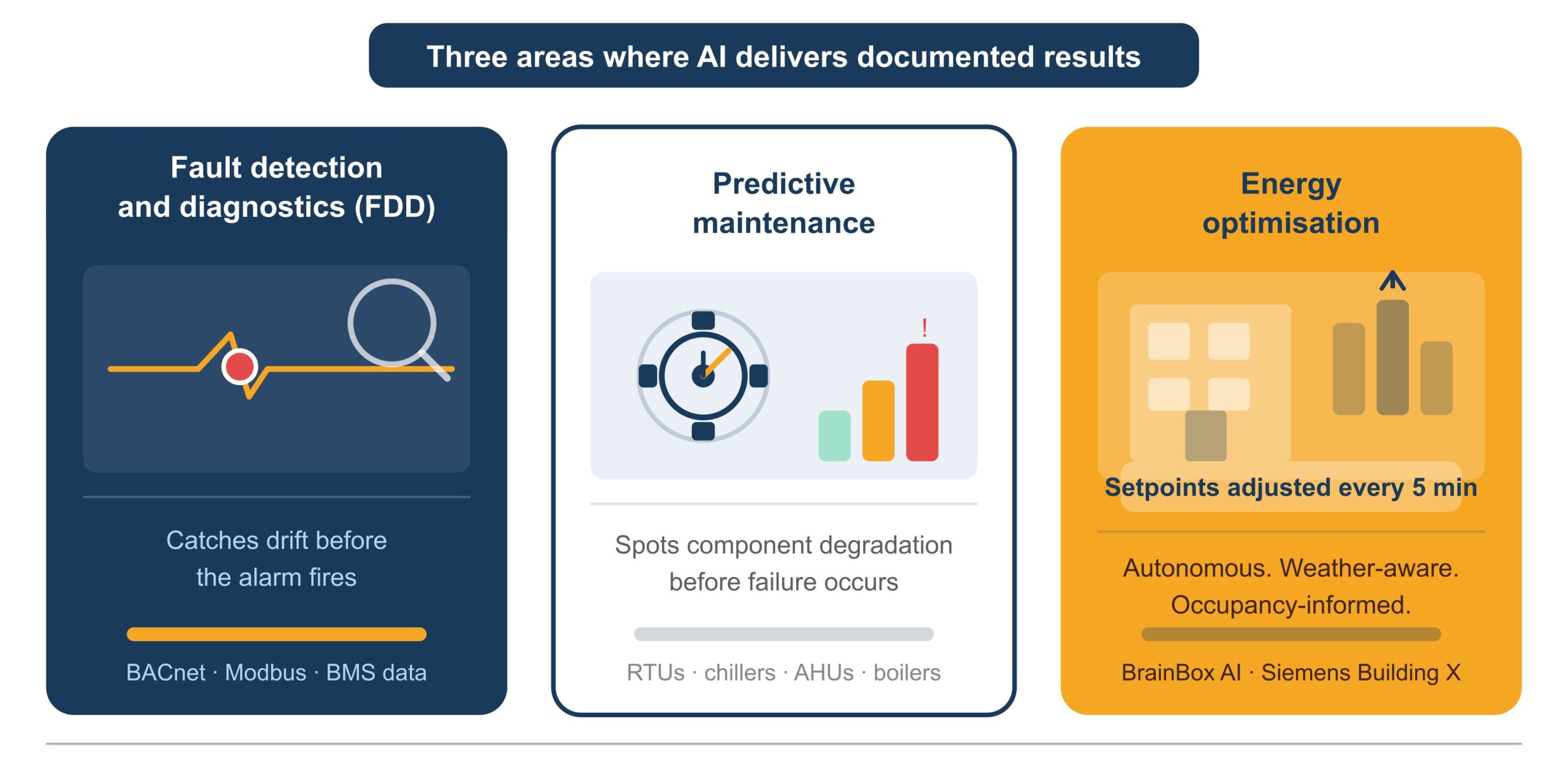
Fault detection and diagnostics (FDD)
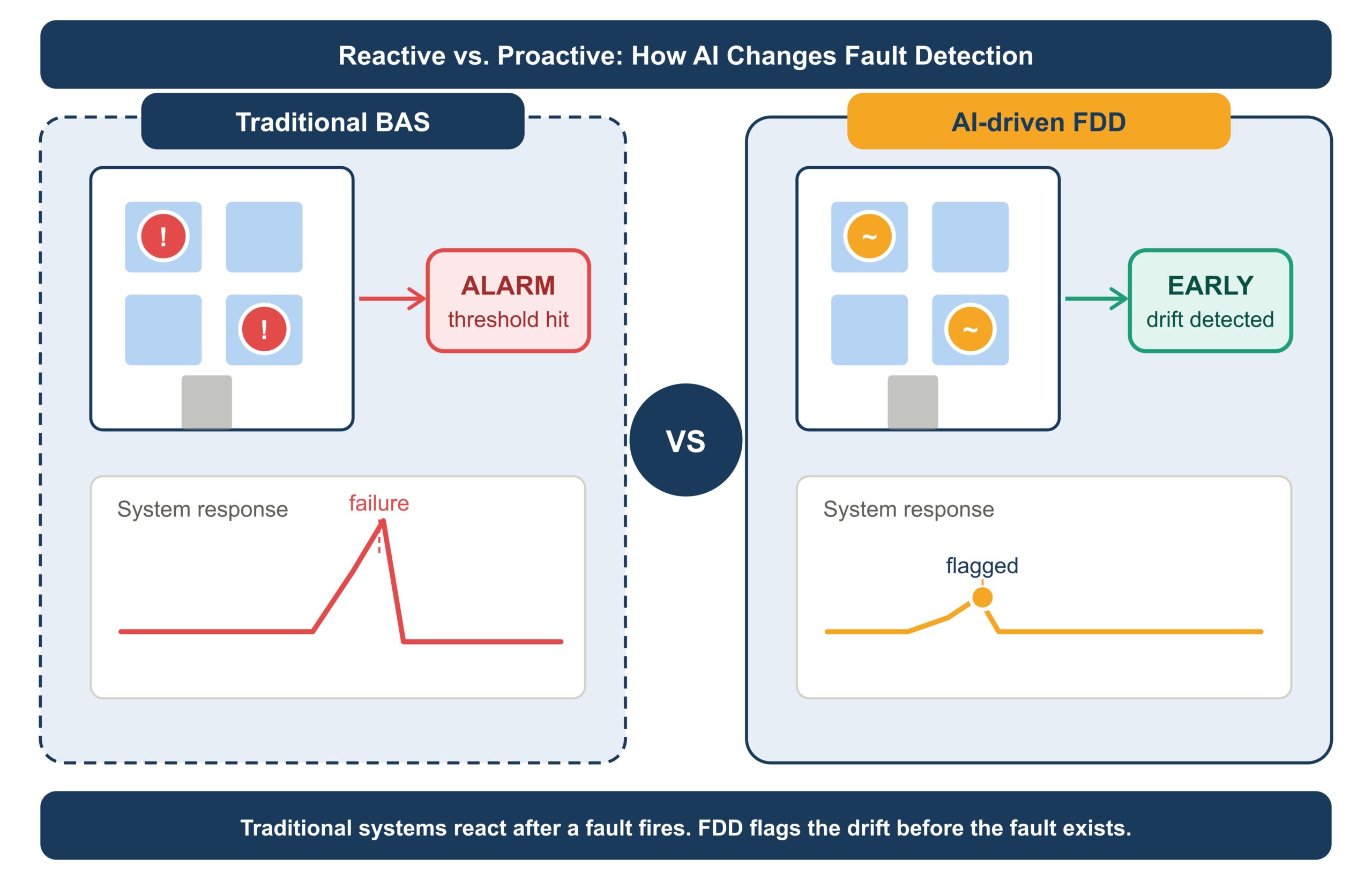
The strongest current application of AI in commercial HVAC is fault detection and diagnostics, a category the industry refers to as FDD. Traditional building automation systems can tell you that something is wrong, usually after a threshold has been crossed and an alarm fires.
AI-driven FDD works differently: it builds a continuous model of how a building’s HVAC equipment behaves under normal conditions, then flags deviations before they become threshold events.
In practical terms, this means a chiller’s chilled water supply temperature sensor slowly drifting, a VAV box hunting more than usual, or an air handling unit’s supply fan drawing more amperage for the same airflow can all surface before any fault code fires, and long before an unplanned outage disrupts operations, displaces occupants, or triggers emergency service costs.
Predictive maintenance
Predictive maintenance is the other area where AI is delivering legitimate results. By continuously monitoring equipment behavior, vibration patterns, runtime hours, and energy signatures, these systems can identify degradation trends that suggest a component is approaching failure. The logic is sound, and the technology has matured enough that it’s no longer speculative.
Energy optimization
Then there’s energy optimization. AI platforms that ingest building data over weeks and months, combined with weather forecast data and occupancy patterns, can support smarter scheduling decisions.
- BrainBox AI, a Montreal-based company that has deployed its platform across commercial buildings internationally, builds a thermal model of the building and adjusts setpoints on RTUs, chillers, boilers, and VAV (Variable Air Volume) systems every 5 minutes autonomously.
- Siemens is one of the HVAC automation companies we work with at SMP LeBlanc, and one of its platforms, Building X, takes a digital twin approach by running a virtual model of the building in parallel with physical systems.
- Verdigris uses electrical signature analysis to monitor current draw across building systems without installing sensors directly on HVAC equipment.
These are meaningfully different technical approaches to the same general problem, and all three have documented real-world track records.
“The conversation kept returning to time and how intelligent systems can support teams by reducing manual workload without removing human oversight.” — Emily Martis, Director of Product Management, BrainBox AI, at AHR Expo 2026
Notice the phrase at the end of that quote: without removing human oversight. That’s the part of the conversation that tends to get dropped in the enthusiasm around AI. We’ll come back to that.
The Part of the AI Conversation That Deserves More Attention
Here’s where things get more nuanced. And this is worth understanding carefully, especially if you’re a building owner or facility manager evaluating AI tools for your property.
Every AI system in commercial HVAC relies on sensor data. The machine learning models are only as accurate as the information coming in, and sensors, even well-installed ones, are not static:
- Temperature sensors develop calibration drift over time.
- Flow sensors in hydronic systems accumulate deposits that affect readings.
- Pressure sensors in ductwork shift.
When this happens gradually, as it typically does, an AI system has no automatic way to know that its baseline data has changed. It learns from the data it has. And what it learns may be a very confident, very systematic picture of a building that no longer reflects what’s actually happening inside it.
This is a documented challenge in the research literature on FDD systems. Sensor drift is consistently identified as one of the core failure modes for automated diagnostics, not a hypothetical concern but an observed pattern in deployed systems. The technology can sometimes detect drift by cross-referencing related data points, but it doesn’t catch it reliably every time.
There’s also an important distinction between what AI does well and what it cannot do at all. A well-cited observation from energy engineering professionals is that AI application in HVAC requires clean, calibrated, trustworthy data from systems that were often not designed to provide it. That gap between the theoretical performance of a platform and the actual condition of the building it’s been deployed in is where most real-world disappointments happen.
And then there’s what no sensor array currently replicates in a cost-effective way. A technician who has spent years in commercial buildings notices things that don’t show up in a data feed. Airflow that sounds slightly wrong in a corridor. A temperature difference that shouldn’t be there between two adjacent zones. A heating coil that looks fine on the BAS but is partially fouled. These aren’t mystical observations. They’re the product of field experience, and they continue to matter in ways that AI has not replaced.
“For AI to optimize energy performance, the system must be obsessively and perfectly instrumented.” — Jeff Ihnen, Michaels Energy
That’s an honest assessment from an energy engineering firm. The premise sounds simple, but the reality in most existing commercial buildings is more complicated.
Why More Efficiency Can Paradoxically Mean More Risk
This is one of the more counterintuitive things worth sitting with for a moment. As AI tools increase the operational efficiency of building systems, they also increase the amount of process that happens without human eyes on it. That’s the point of automation. But it also means that when something does go wrong, whether a sensor drifts, a control parameter gets set incorrectly, or an AI model makes a recommendation based on faulty data, the error may run uncorrected for longer.
The industry is already talking about this directly. At AHR Expo 2026, one of the recurring themes was that AI transparency is no longer optional. Building operators and facility managers need to see not just what an AI system recommends but why it’s making that recommendation. The shift from outputs to explainability reflects a growing recognition that human oversight can’t be passive when automated systems are making continuous decisions about how buildings operate.
More automation means more vigilance is needed, not less. A human spot-check of a system that runs manually catches problems at the point of operation. A human spot-check of a system running on AI-driven automation needs to verify the data the system is relying on, the logic it’s applying, and whether what it’s doing in the building matches what it’s being told to do. That’s a more technically demanding oversight task, not an easier one.
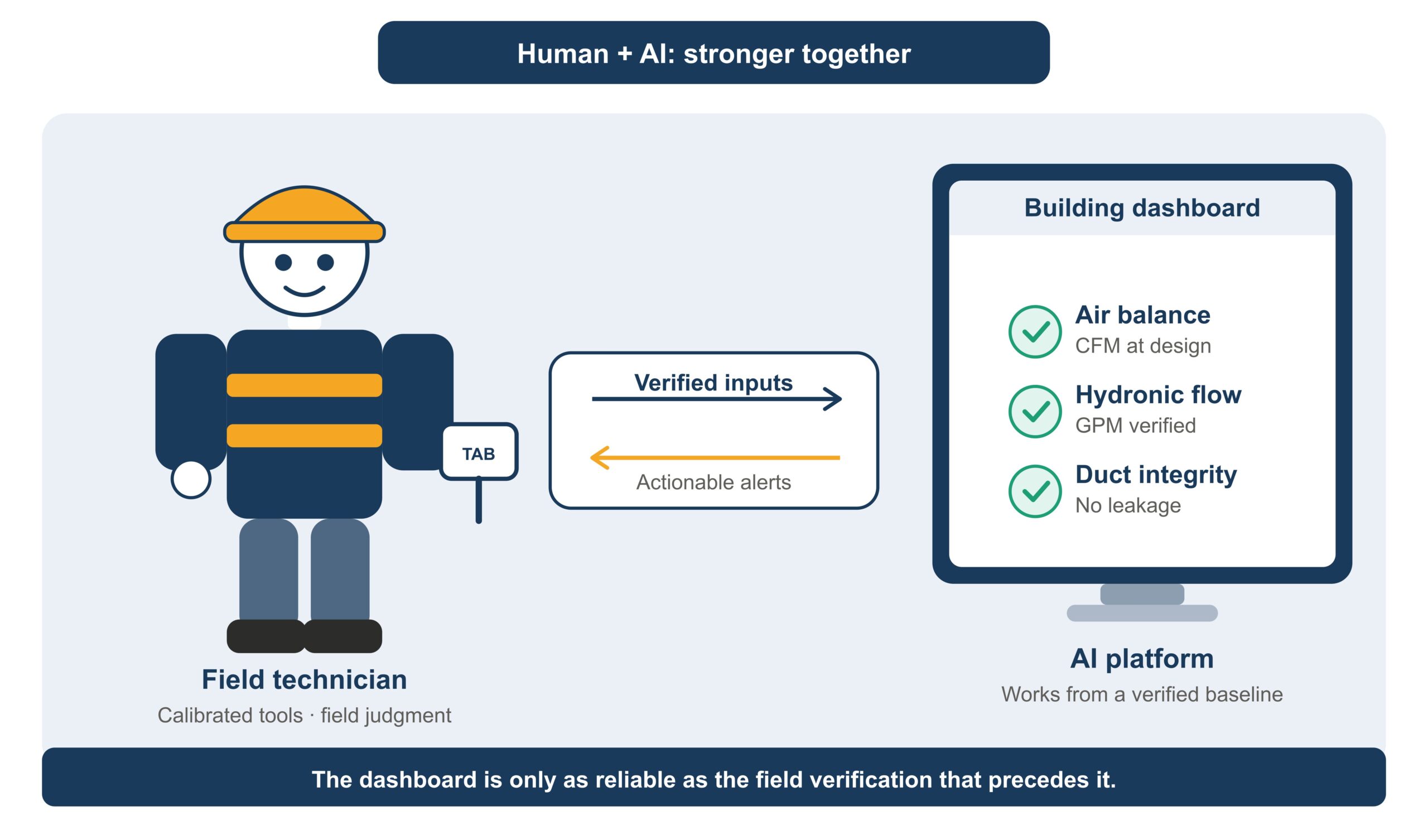
This is why commissioning, balancing, and field verification remain foundational work, not legacy holdovers from a pre-AI era. They’re the mechanism by which humans confirm that the physical reality of a building matches what any monitoring system, AI or otherwise, is working from.
The Foundation That Makes Any Monitoring Platform Useful
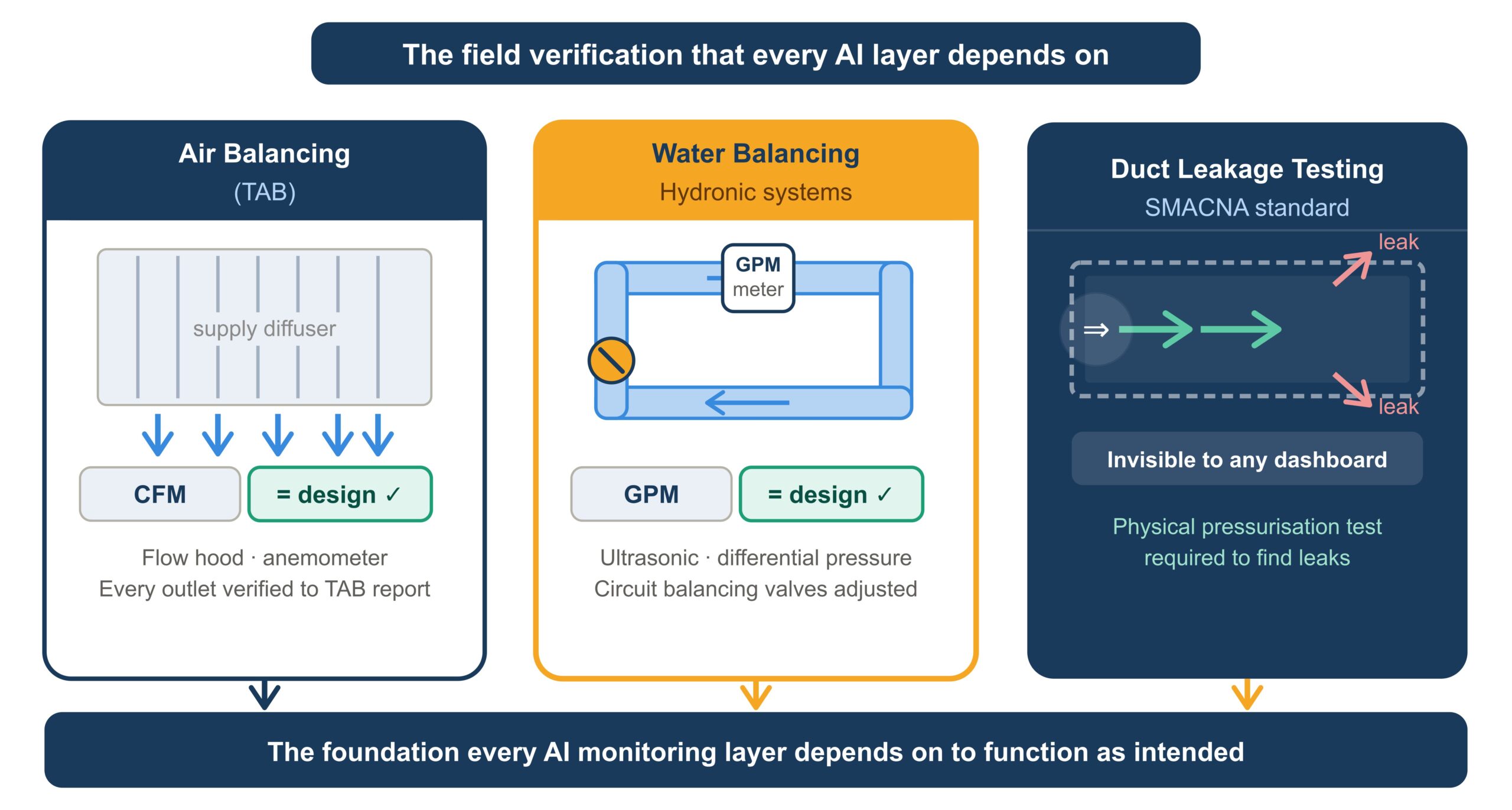
Air balancing, water balancing, and duct integrity testing are the three field verification processes that sit at the base of any properly functioning commercial HVAC system. No monitoring platform, AI or otherwise, can substitute for them.
Airflow that hasn’t been balanced to design specs, hydronic flow that’s drifted from its intended GPM, ductwork leaking conditioned air into a ceiling plenum before it ever reaches an occupied zone: until each of these is physically tested and verified, none of it shows up on a dashboard, and energy is consumed in ways that stay invisible until someone traces the problem back to the source. It takes calibrated field tools and someone who knows how to use them to find it.
At SMP LeBlanc, we’ve done this work across Quebec on projects ranging from seniors’ residences to performing arts venues to mixed-use commercial buildings, including air balancing and duct leak testing at the Maniwaki Seniors’ Home and the Theatre du Nouveau Monde, and water balancing at Le 900 Saint-Jacques.
Major mechanical contracting firms in the province contract us for this verification work because it requires calibrated field expertise. Getting it right is what allows everything else in a building’s HVAC ecosystem, including any intelligent monitoring layer, to actually function as intended.
What This Means If You Manage a Commercial Building in Quebec
The most useful frame right now is that AI is an intelligence layer, not a replacement for properly functioning mechanical systems. A BrainBox AI deployment on a building with verified airflow distribution, calibrated sensors, and recently confirmed hydronic balance will perform differently from the same platform deployed on a building where none of that work has been done. Both buildings will get a dashboard. Only one of them will actually benefit from what the dashboard is showing.
Before committing to any AI or smart building platform, there are three questions worth putting directly to any vendor:
- How does this connect to my existing BMS infrastructure? Is it BACnet-compatible, or does it require proprietary hardware? What’s the learning period before it can make reliable recommendations?
- What does the building need to have in place for this to work as described? A candid vendor will tell you about sensor coverage requirements, calibration expectations, and the importance of recently verified system baselines.
- How does the platform explain its recommendations? Transparency into the reasoning behind setpoint changes and maintenance alerts is what makes AI-driven oversight actually workable for a facilities team.
Vendors who give you a straight answer to those questions are worth having a longer conversation with.
AI in HVAC is not a disruption to the field. It’s an evolution in the tools available to people who already know what they’re doing. The industry has absorbed technologies like this before, and in time, it will absorb this one, too. The buildings that perform well through that transition will be the ones where the mechanical fundamentals haven’t been treated as optional.